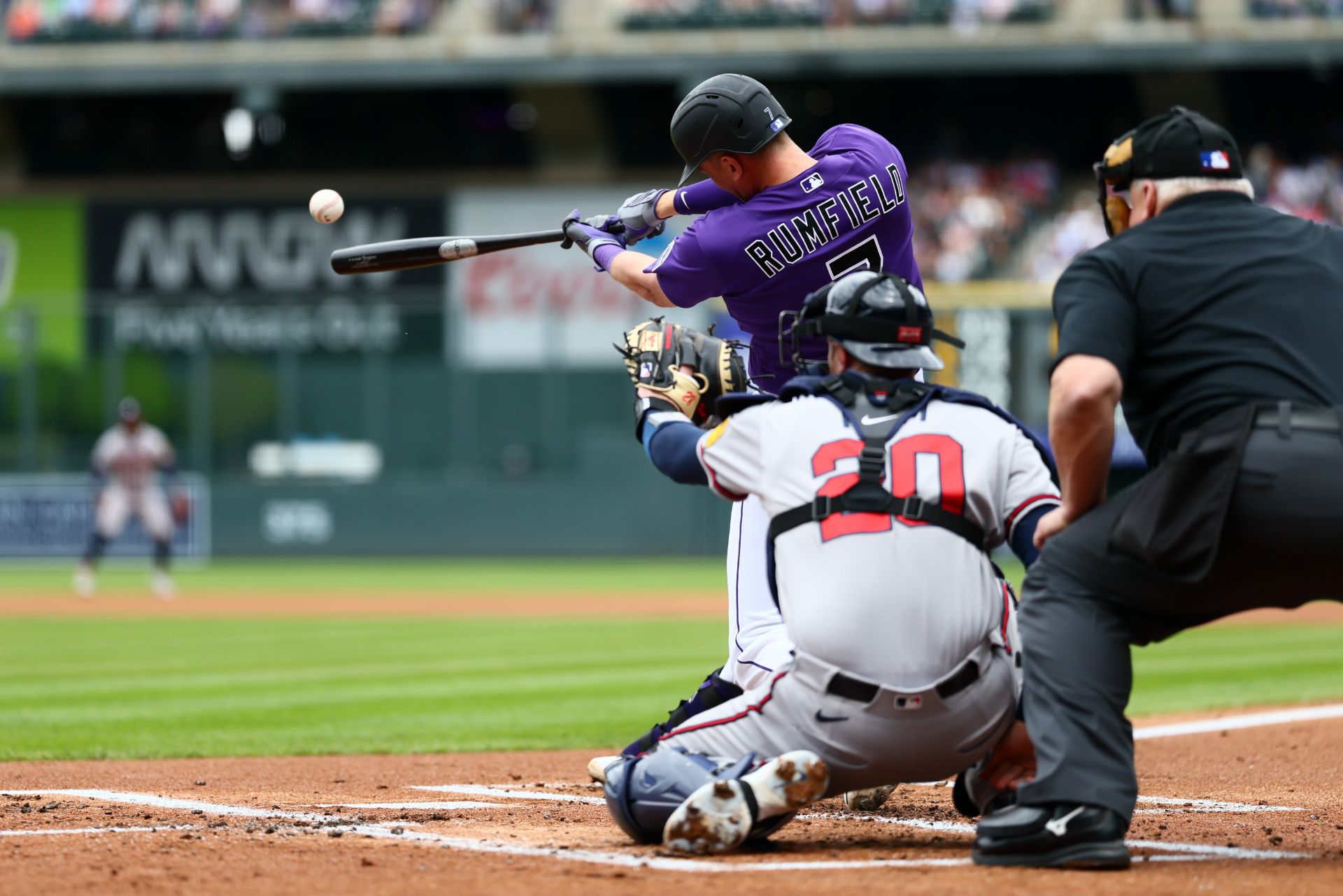
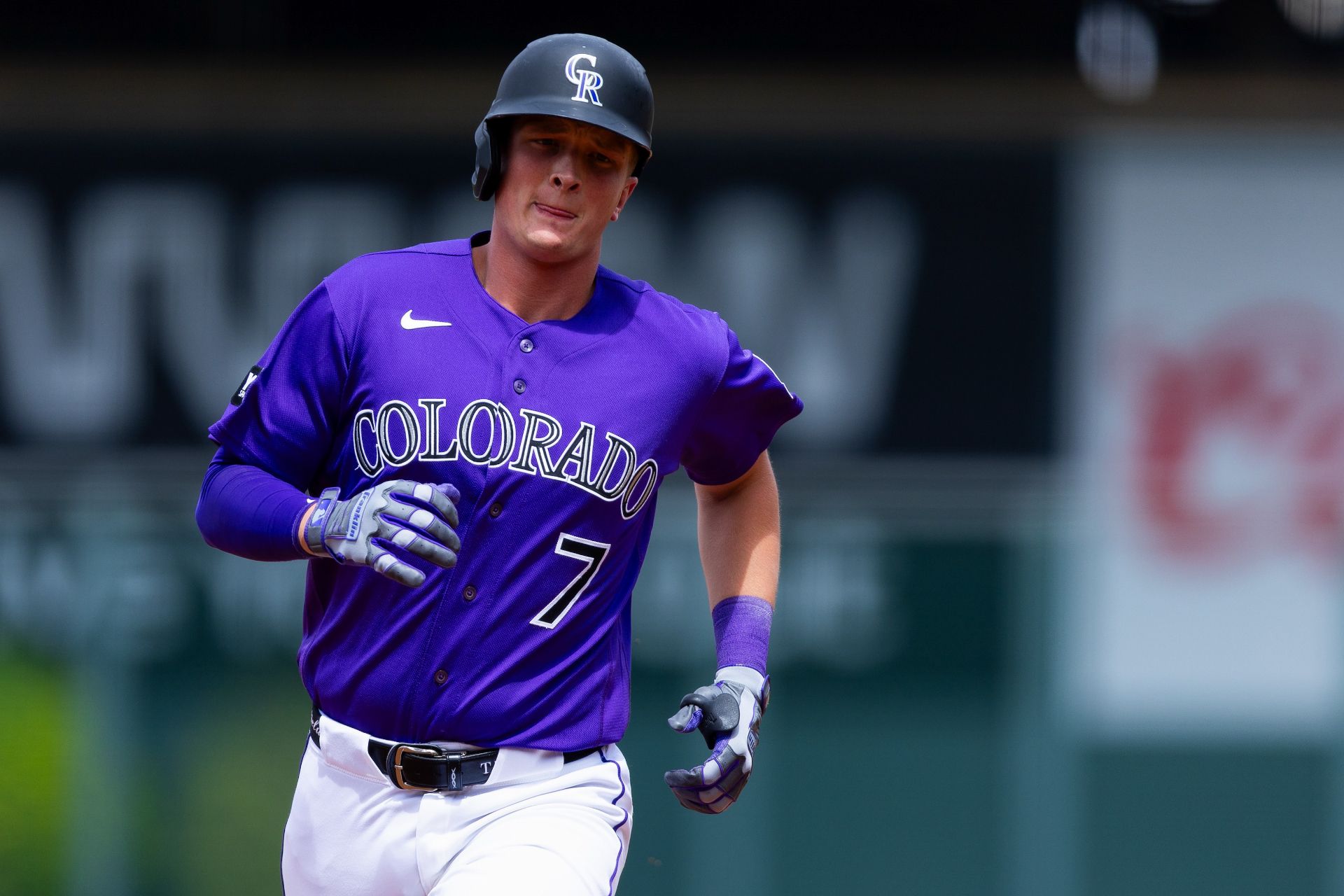
DENVER -- Rookie first baseman TJ Rumfield’s regular presence in the starting lineup stands as a testament to the Rockies’ dedication to establishing putting the ball in play as a standard. Rumfield leads the team with 140 plate appearances, but his 23 strikeouts are fewest among the nine Rockies who have stepped into the batter's box at least 80 times. Troy Johnston, who was touch-and-go to make the team until the final days of camp, has 24 strikeouts and has earned himself some regular playing time as well. The production is increasing. Included in his .268/.329/.425 slash line is a current surge – .288 with five doubles, two home runs and 11 RBIs with four walks and just eight strikeouts in his last 15 games. In Sunday’s 11-6 loss to the Braves, he went 3-for-5 with a home run and an RBI single. Mickey Moniak homered twice in the losing effort, his fourth multihomer game of the season. Rumfield’s key is bringing the skills he learned from when he first picked up a bat to the Major Leagues. “It’s how I was raised – playing pepper in the backyard or playing Wiffle ball, you’re going to try to hit everything – it’s tough to do at this level, but you just want to hit it where it’s pitched,” Rumfield said. “That’s what this game is about, just being able to react. “I’ve always taken pride in being able to put the ball in play. And no matter how many strikeouts happen in the game today, I always take pride in putting the ball in play and trying to do something other than striking out.” |
|
|
Rumfield arrived in a pre-Spring Training trade with the Yankees, and is the only position player on the active roster who had not appeared in the Majors before this year. Whether it was guys with little previous experience, such as Johnston or third baseman Kyle Karros, or more-veteran players such as Willi Castro or Edouard Julien, the Rockies wanted to establish a lineup of players who didn’t fall into the swing-and-miss holes that have dogged the team’s players in recent years. In addition to improving the record at the Major League level, the way Rumfield and others have earned playing time is a message to players throughout the farm system. Strike-zone proficient plate appearances get noticed, even above gaudy Minor League numbers. “One of the things we’ve talked about since my first week here was this idea of organizational consistency,” Rockies president of baseball operations Paul DePodesta said. “Whatever we do at the big league level, we want to do all the way through the organization, even into our scouting operations. “It’s something we’ve tried to do through the course of spring, and now the first month of the season throughout the Minor Leagues, to really have one language when we talk about hitting, one language when we talk about pitching. It’s starting to take hold in the Minor Leagues, but we still have a lot of work to do.” Players on and off the active roster could benefit from listening to Rumfield discuss pride in putting the ball in play. It’s the language of the Rockies’ future. |
MLB MORNING LINEUP PODCAST |
Because of the inclement weather headed to Denver – a tradition during May of a Rockies season – today’s game against the Mets was moved three hours earlier, to 3:40 p.m. MT. Here are details. |
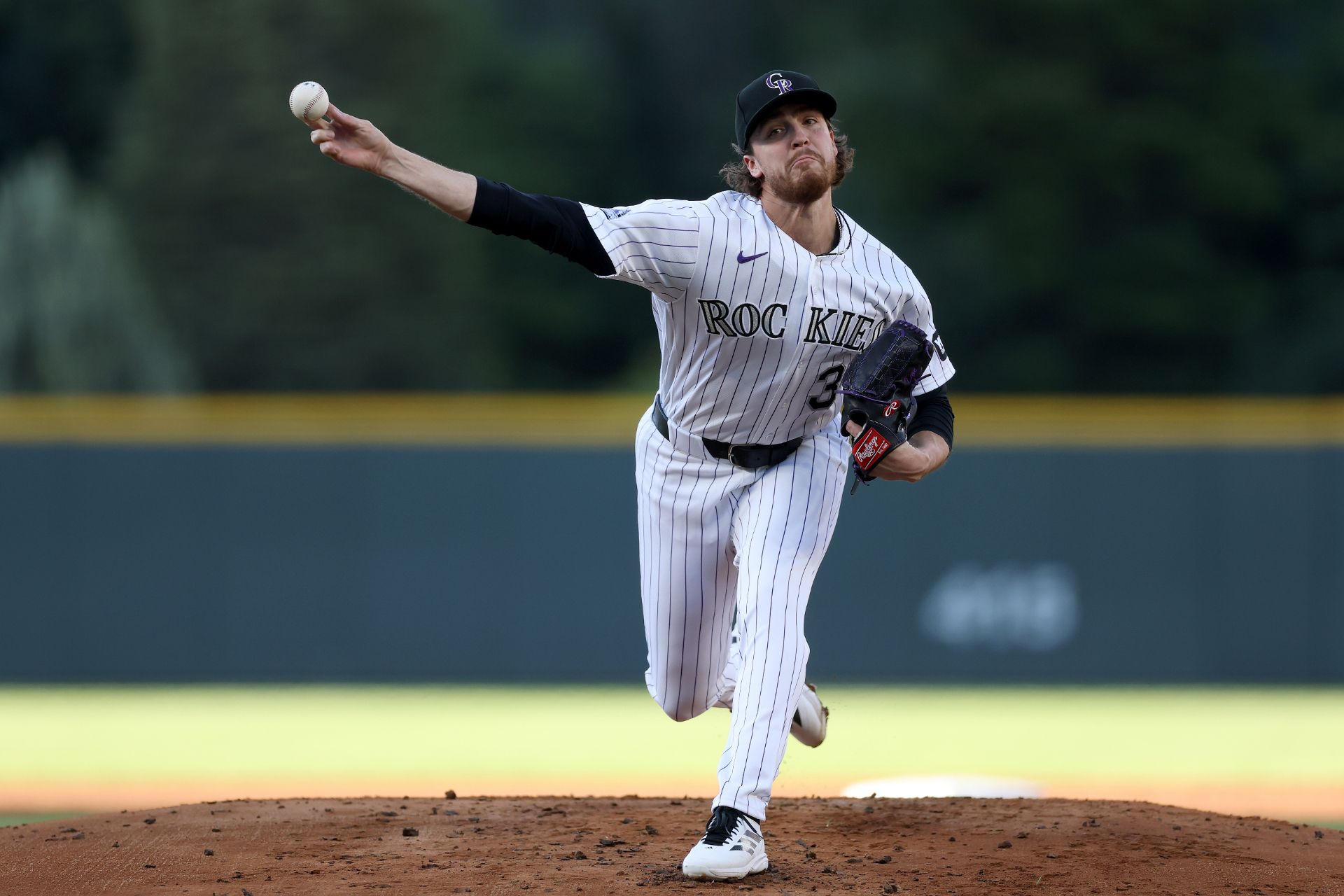
The Rockies’ use of an opener on scheduled days for Chase Dollander to pitch designed to have him working later in the game than a typical starter. With effectiveness in general waning when a pitcher faces hitters for a third time, the theory is when the lineup turns over for that third time, he will be facing the lower part of the order later in the game. • A look at the Rockies’ approach with Dollander via Instagram The oddity is Dollander has significantly better numbers against batting order positions 1-5 (.200 BA, .280 SLG, 29 K, 32.7% whiff rate) than against spots 6-9 (.258 BA, .468 SLG, 13 K, 25.9% whiff rate). The Rockies also are using the third time through the order as a guideline and not a limit. Dollander threw seven scoreless with seven strikeouts against the Mets on April 26, earning the decision in the 3-0 victory, and hitters went 1-for-8 with three strikeouts when they saw him the third time. Against Dollander as a reliever, hitters the third time through are 2-for-15 with three strikeouts and two walks. The three openers for Dollander – lefty Brennan Bernardino and righties Jimmy Herget and Juan Mejia – have given up at least one run in four of the six games. But the club sees the ability to have Dollander on the mound later in games outweighing being behind by a run or two when Dollander enters. |
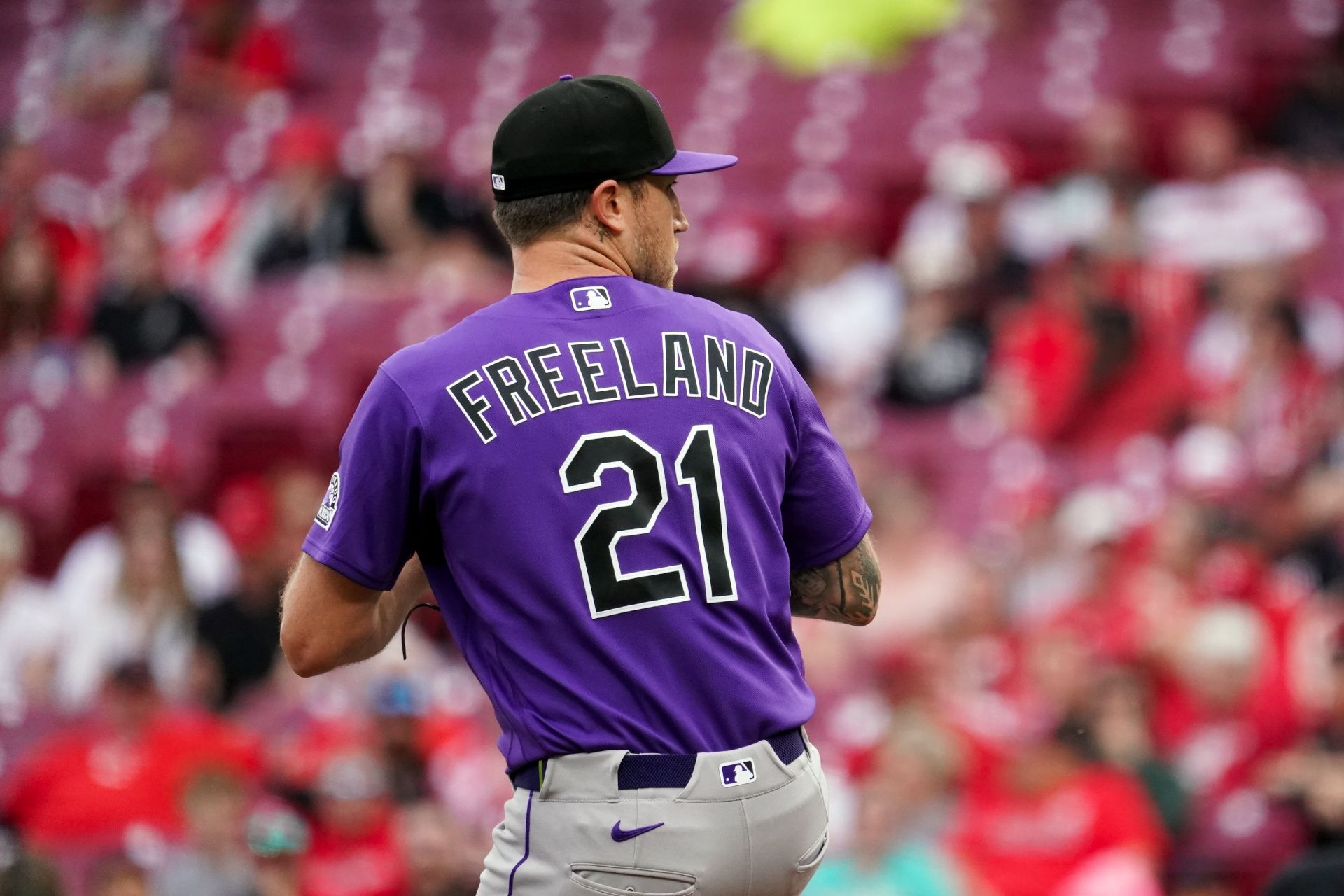
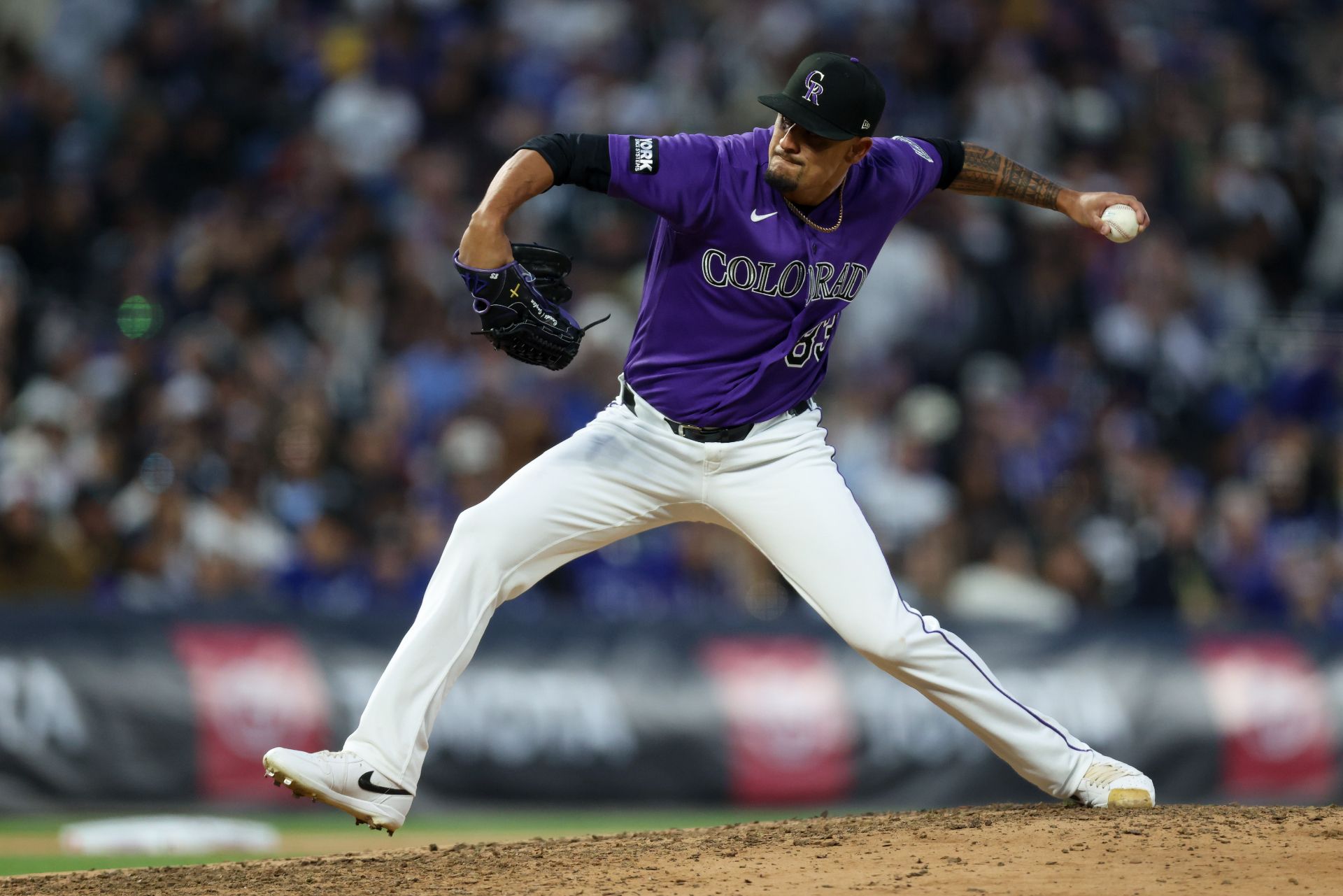
With teams having multiple uniforms and wanting to display them as much as possible, what the Rockies (or any team) wear for a given game is a little more involved than the old tradition of the starting pitcher walking in and picking a jersey. Some teams have close to a set schedule, devised by the organization. Mike Pontarelli, who runs the Rockies’ clubhouse, said although club policy has the team wearing purple at home on Mondays and the City Connect uniforms on Fridays, the Rockies maintain some old-school thoughts. “We do value the starting pitcher’s requests,” Pontarelli said. Lefty Kyle Freeland loves the purple jersey and wears it when possible, at home or on the road (although the league makes sure teams coordinate so there aren’t nights where, say, the Rockies wear purple and the opponent wears dark blue). Dollander, whom the Rockies treat as a starter, showed a preference for the traditional white jersey with purple pinstripes, and that is kept in mind. Pontarelli said righty Tomoyuki Sugano sometimes asks what his stats are in a given uniform before making a choice. The big question is whether the Rockies will ever go back to a black jersey, even if it isn’t the fondly remembered sleeveless top that was so prevalent during the streak that landed the team in the 2007 World Series. No MLB team is wearing sleeveless jerseys these days. “I think vests are a thing of the past, but black jerseys are cool with any team in any sport,” Pontarelli said. “I don’t know if it’ll come back for sure or in the near future, but I’m optimistic.” |
RIGHT-HANDER (!) BRENNAN BERNARDINO? |
For the pregame time not occupied by meetings, workouts or batting practice, the Rockies have a portable dartboard in their clubhouse, home and away. In Cincinnati, there was a conspicuous oddity: lefty reliever Brennan Bernardino, taking his aim while throwing right-handed. He doesn’t do this to preserve his baseball-throwing arm. “It’s funny: I write right-handed, I eat right-handed,” Bernardino said. “Playing basketball, I dribble with either hand, but I was always more comfortable driving to my right.” This is more common among baseball players than one would expect. Former Rockies pitchers such as right-hander Jason Jennings and left-handers Denny Neagle and Tyler Anderson signed autographs with the opposite hand. Orioles Hall of Fame third baseman Brooks Robinson was left-handed in tasks that didn’t involve baseball. Famously, former Rockies third baseman Nolan Arenado’s left-handed jump shot showed up during a basketball activity during Spring Training. Through 15 lefty appearances as a reliever or opener with the Rockies, Bernardino, previously with the Mariners and Red Sox, is 2-1 with a 2.03 ERA. Bernardino, 34, pitched in Mexico for Jalisco while searching for a Major League chance. While there, he targeted Colorado as a place he would like to pitch. “Jared Wilson [who still pitches in Mexico] and I were looking at teams, like, ‘If we’re presenting ourselves to teams or trying to have our agents talk to teams, we said we’d like to play in Colorado,” Bernardino said. “Jalisco is roughly the same elevation as Colorado, and if we know how to pitch there, we could be successful in Colorado.” |
|
|
FORWARDED FROM A FRIEND? SUBSCRIBE NOW |
|
|
To subscribe to Rockies Beat, visit this page and mark "Rockies Beat" from our newsletter list. Make sure you're following the Rockies or that they're checked as your favorite team. |
|
|
|