Welcome back to the Mets Beat newsletter! For this edition, MLB.com's Jared Greenspan is filling in for Anthony DiComo. |
|
|
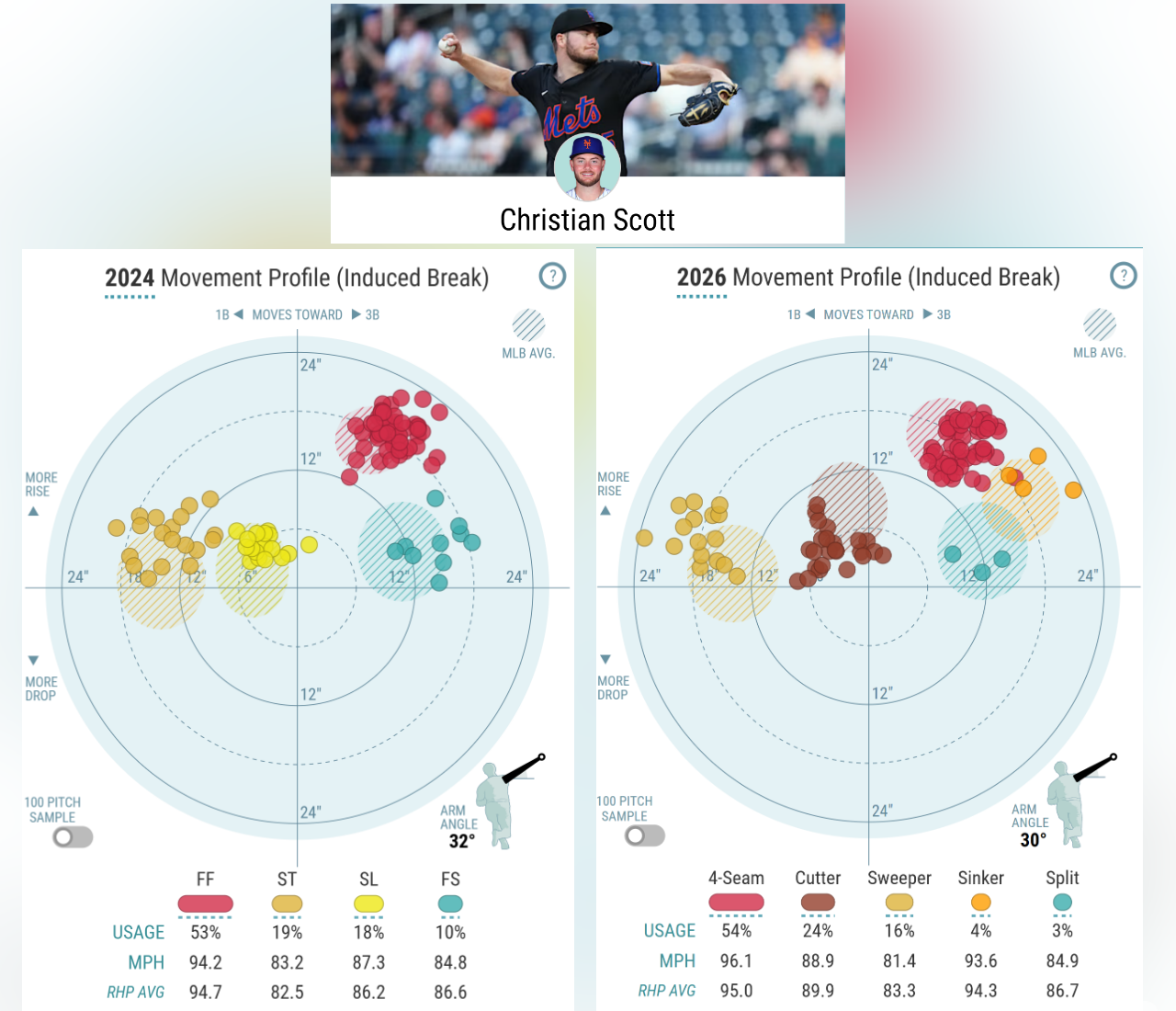
Christian Scott is not the same pitcher that he was two years ago, when he broke into the Majors as the Mets’ top-ranked pitching prospect. Thanks to a revamped pitch mix, Scott is even better. The 26-year-old righty recorded just three outs in a bumpy return to the Majors last month. But an injury to Kodai Senga offered Scott a second chance, and he has run with the opportunity. In two starts since his recall, Scott has pitched to a 2.79 ERA, recording 14 strikeouts in 9 2/3 innings while flashing much of the promise he showed two years ago. “The stuff is electric,” Mets manager Carlos Mendoza said in Spring Training. Different pitching models try to quantify how “electric” a pitcher’s repertoire actually is. One of the most popular models is FanGraphs’ Stuff+, which attempts to evaluate pitches based on qualities like movement, location and velocity. In 2024, Scott’s overall Stuff+ grade was 100. This season, he is significantly nastier, with a Stuff+ rating of 108. Yes, it’s a small sample size: Scott has thrown just 11 2/3 innings and 199 pitches. But this is something that stabilizes fairly quickly, especially compared to other metrics. And that is an impressive number. For reference, Scott's rotation mate, Nolan McLean, has the same overall Stuff+ grade. So, what changed? |
The first thing you’ll notice here is that Scott is working with two new pitches. He replaced his slider with a cut-fastball, using a grip that he picked up from former teammate Drew Smith during their respective rehabs. Though the cutter has similar movement qualities as the slider, it’s thrown 1.5 mph harder. With the cutter, Scott can attack left-handed hitters differently. He had strong platoon splits as a rookie, with lefties (.333/.567 BA/SLG) faring better than righties (.167/.300). Those problems have gone away this year. Lefties are 2-for-23 with zero extra-base hits against Scott through his first three starts, in part because he’s using his cutter 34% of the time. Scott is also sprinkling in a two-seamer, which is slower than his four-seam and runs inside to right-handed hitters. It doesn’t have any standout physical qualities, but that’s not entirely the point. What matters is that Scott now has a three-fastball mix. Pitchers across the league are picking up multiple fastball shapes, and for good reason. These fastballs are thrown at similar speeds and out of a similar window, but they have vastly different movement profiles. That makes it nearly impossible for a hitter to match his bat path to the pitch. There’s no spin or velocity difference to pick up on. Batters could sit on Scott’s four-seamer -- his only hard offering -- in 2024. That’s not the case anymore. Scott’s four-seam fastball 2024: .265 BA / .388 SLG 2026: .158 BA / .211 SLG On its own, the four-seamer is also better. Mainly, the velo is up. Scott averaged 94.2 mph on his fastball in 2024; it’s spiked to 96.1 mph in ‘26. That’s likely a byproduct of Scott adding 8-10 pounds of muscle in his rehab, which he hoped would improve his stamina. Scott’s four-seam fastball velocity in the fifth inning (95.6 mph) and first inning (95.9 mph) are more or less the same. |
Scott’s sweeper, his best breaking pitch, is also moving differently. It’s thrown slower, down from 83.2 mph to 81.4 mph. Slower pitches tend to break more -- movement requires time -- and that’s what’s happening here. Scott’s sweeper averages 17.5 inches of horizontal break, which is not only four inches more than what he averaged in ‘24, but also 3.0 more inches of horizontal movement than comparable pitches (those thrown at a similar release point and velocity). Only 14 qualified sweepers break more than Scott’s. |
|
|
MLB MORNING LINEUP PODCAST |
|
|
These new shapes complement the traits that already make Scott unique. He operates on an east-to-west plane, and the added break on his sweeper allows him to continue to work horizontally across the plate. His fastball plays up because of plus extension -- Scott releases the baseball closer to home plate than the vast majority of pitchers -- and the extra tick of velocity makes it even more difficult for hitters to catch up. The work that Scott put in during his rehab to revamp his pitch mix is paying off. From a “stuff” perspective, he is a better pitcher. That certainly bodes well for the Mets, who will continue relying on their rotation to help dig their way out of an early-season hole. |
|
|
FORWARDED FROM A FRIEND? SUBSCRIBE NOW |
|
|
To subscribe to Mets Beat, visit this page and mark "Mets Beat" from our newsletter list. Make sure you're following the Mets or that they're checked as your favorite team. |
|
|
|